


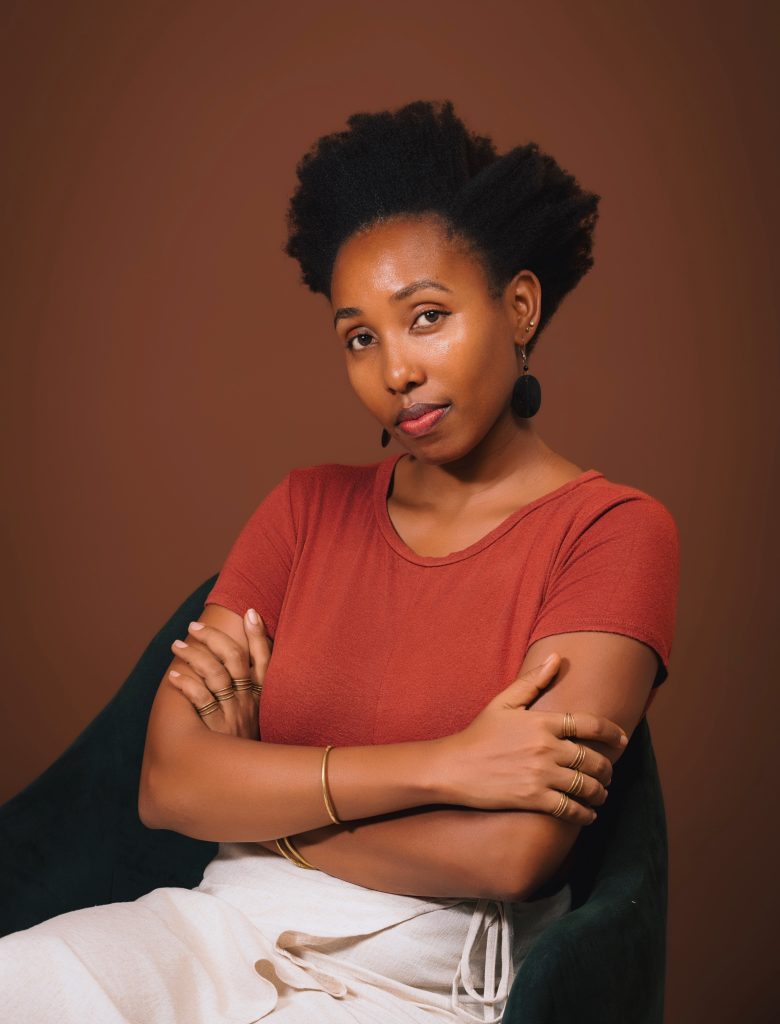
Photograph of Myriam Birara.
This conversation took place on Google Docs between Myriam in Kigali and Alain in Musanze.
ALAIN: You first came to Kigali at the tender age of two. Having your parents lived in the Congo for sometime, is there any Congolese influence on your work as both a filmmaker and a painter? Are there some art or Congolese rumba played in the house while you grew up that remain among things that influenced your taste in art?
MYRIAM: The part of Congo where I was born is Masisi, in the east. It’s a predominantly Kinyarwanda-speaking region with deep ties to Rwanda, through colonial borders, migration, displacement, and resettlement.
Still, Congolese influence was very present in my life. At home we spoke Swahili before I can even remember. My earliest memories, though, are of speaking a broken Kinyarwanda, and I struggled with it at school, especially in Kinyarwanda lessons.
We grew up listening to Congolese music. In my household it was mostly religious music, but when we visited extended family we encountered the real rumba: Koffi Olomidé, Papa Wemba, M’bilia Bel… Most of my siblings and cousins were also into Congolese comedies. I’m not much of a comedy person myself, but they did shape my sense of storytelling: the way those films detailed everyday life, especially from a lower-class perspective.
My mother played a big part too. As we grew up, she would reminisce about her youth in Congo: the music, the places she traveled to, the food. We would put on some rumba and she would show us the dance moves and translate the Lingala lyrics for us. It was beautiful.
Rumba was highly admired in my house. My siblings were into music and sang in choirs, and they praised the Congolese music industry as the best in the region. So rumba is more than music to me; it brings back memories.
I think my early childhood, the late nineties, marked the way I see and appreciate life. In all my practice I tend to go back, and I’m not just a nostalgic person. The years from the sixties to the nineties were vibrant and poetic, and the colors, fashion, and architecture were still honest and profound . In the background of those moments, there was mostly the Izasabwe show in the afternoons, and the oldies being played included a lot of rumba, but mostly Rwandan, karahanyuze. That brings back vivid memories of the time.
Growing up between languages also shaped the way I pay attention to words. I love, love, love how people communicate, both with words: how they’re used, or not used at all, the silence, because there is so much silence, and still people communicate through it. That shaped the way I observe and express things visually.
ALAIN: When was the first time you thought to yourself: “I want to make a film”, and what were the circumstances?
MYRIAM: I drew a lot as a kid. Drawing has always been an escape for me, and a way to understand the world around me. I also started drawing comic stories with speech bubbles, which entertained my family and some of my classmates.
I never thought it could be a career. I wanted to be a medical doctor so I could cure my mother’s asthma.
That changed when I watched a Rwandan film at the end of 2009 or the beginning of 2010, called Long Coat. It wasn’t the first Rwandan film I had seen, but it portrayed a life that felt familiar and poetic at the same time, in a way I had never seen before. It awakened a sense of wonder in me, and I knew I wanted to make films.
ALAIN: The Bride relies on the sounds of the environment rather than a soundtrack. Why?
MYRIAM: I want my films to rely on environmental sound instead of a musical soundtrack because it creates a raw, believable sense of reality and deep immersion. I like to build a soundscape from what the environment itself offers: howling wind, distant traffic, footsteps, dripping water, a dog barking far away. These sounds anchor the film in absolute reality.
In The Bride, nature also serves several purposes. One of them is to give the character, and the audience, a moment to breathe before continuing the journey.
ALAIN: Kigali has outgrown what it looked like in the 90s. What went into location scouting? Were you trying to replicate the 90s, and what challenges did you face with regards to the changing Rwandan landscapes and its urbanisation/gentrification? What attracted you to that particular location in the film?
MYRIAM: Honestly, I knew Kigali wasn’t going to be of much use for the 90s I was trying to replicate. So I went to the countryside to see if I could find a landscape and a property closer to my vision.
That’s why I chose the northwestern part of Rwanda. I love this region and its people. It’s breathtakingly beautiful, with its climate, its greenery, and a dramatic mountainous landscape.
ALAIN: How did the theme of guterura come to you?
MYRIAM:My first vivid memories are from the late nineties and early two thousands. Guterura, the practice of abducting a woman into marriage, existed before the genocide, but in its aftermath it increased on a bigger scale. With the country trying to get back on its feet, some took advantage of that fragile moment, while others were survivors trying, in a brutal and non-consensual way, to reconstitute something that genocide had destroyed. It was never really spoken about, which is part of why I wanted to bring it into the film. But beyond that, it also gave me a realistic way for my two main characters to meet: Eva, and the abductor’s cousin.
I tried to imagine what it would have been like to live through it, and I couldn’t sit with the thought for long. It raised question after question I couldn’t shake: How would I have dealt with a forced marriage myself? Would I have given up on my dreams? Would I have been compliant, or rebellious? Would I have seen it as something larger, the rebuilding of a family in the wake of a genocide that had massacred so many? Those questions became the seed of The Bride.
ALAIN: In the words of Mutiganda wa Nkunda, your film The Bride is the best film ever made in Rwanda. Myself I believe you are the best filmmaker in Rwanda, and this is not to flatter. How did you set such a high bar for yourself making The Bride? Also, does The Bride come with too much pressure for yourself in your next projects?
MYRIAM: Making The Bride, especially with a limited budget as a first-time filmmaker, I was driven almost entirely by my vision. The film felt urgent, like a child that had to be born.
I was just following my passion. Honestly, I didn’t think much about setting a high bar. I was focused on giving everything I had to the vision in front of me, and on collaborating with my cast and crew at every stage, all of us working to bring the film to life.
I had no idea where it would reach. My wish was simply to make a film that would find its audience, not only here, but even in far-away places, no matter how small that audience might be. That’s how I’ve always watched films myself, discovering small films from the Philippines, Peru, Senegal, and finding something in them that spoke to me despite the distance.
As for pressure, I think it’s only natural, as an artist, to want to top your previous work. But not every creative process flows smoothly. Sometimes it can feel almost cruel, whether that’s just part of the process itself, the weight of a previous work, or a bit of both, and more.
I’m writing my second feature now, and the process isn’t always linear. I’ve made peace with that. It’s part of it.
ALAIN: Have you ever watched films on illegal online streaming platforms, and what are your thoughts on those platforms, especially their usage in Rwanda?
MYRIAM: Like many people who grew up with limited access to cinemas or legal streaming, I’ve encountered these platforms. That’s true for a huge number of people in countries with limited distribution.
On the other side, having made films myself, I’ve seen firsthand how concerning the issue of distribution really is. Copyright infringement violates copyright law, and enforcement tends to target the people running these websites, while viewers who use them are still participating in the same illegal act. This affects rights holders directly, and independent filmmakers are especially vulnerable. If people care about filmmakers, the best way to show it is by watching their work legally.
As a country, this is still an issue we face: we don’t yet have enough platforms where people can access our own films.
ALAIN: African films, say Atlantics by Matti Diop, go on to do exceptionally well in Europe, but not in the US. Based on your personal experiences, do you see anything that leads to this trend?
MYRIAM: African films are likely to find greater critical and festival access in Europe than in the United States, probably due to historical ties, a kind of familiarity shaped by colonial history, and funding structures that include African countries alongside other nations in the Global South. The US market, by contrast, tends to focus on domestic blockbusters, leaving almost no space for foreign films, especially low-budget ones.
ALAIN: The Ministry of Youth and Arts has just recently (this very year) established Rwanda’s first official Oscars Selection Committee to submit national entries into the International Feature Film category! Congratulations! What does it mean to the growth of the cinema industry in Rwanda?
MYRIAM: I think this is a meaningful step, both for the industry and for the country. It’s not necessarily a dream for every filmmaker, depending on where they want to take their career, but the possibility of Rwandan films entering the Academy race has tangible potential: it could open up the US market to Rwandan films, a new space that would shed light on Rwandan voices. That, in turn, attracts both local and international investors, and makes it easier for government to see the value in building funding systems that support local filmmakers and productions.
All of this encourages people to see filmmaking as more than an art form. It becomes an economic opportunity worth investing in, which raises the quality and standards of the films being produced to meet that bar.
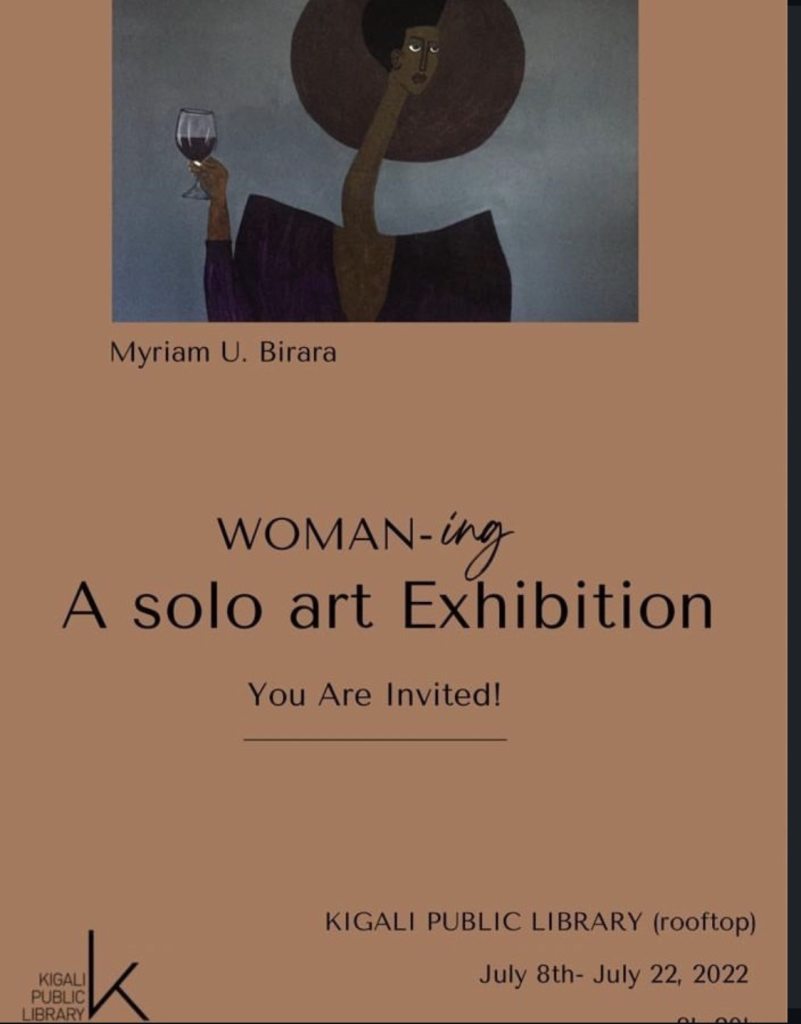
Woman-ing, a 2022 exhibition of the paintings of Myriam Birara.
ALAIN: You paint women in domestic poses, with Rwandan identities such as hairstyles. What inspired your series of portraits of women?
MYRIAM:It’s true that in my paintings I keep returning to women. I do paint men too, just not as often.
I find myself drawn to what I think of as the poetry of the everyday, those familiar, almost invisible moments. My pieces are also very much inspired by memories of my childhood: the fashion, the hairstyles, the graceful posture, mostly set in domestic spaces. They often come to me like poses, or still moments frozen in time. That’s how I saw and remember the world around me.
ALAIN: In Rwanda, like in most African countries, children get their hair cut before school starts. In your paintings, you beautify the Afro, the cornrows, amasunzu, etc. Do you think this tradition of cutting children’s hair is a colonial practice? What are your thoughts on this?
MYRIAM: In Rwanda, and in some other African countries, getting children’s hair cut at schools, or styled in a way that forces naturally coiled hair into other textures, makes natural hair look less professional and less presentable, backward in some contexts, and too modern or untamed in others. I believe this is a colonial legacy and a post-colonial effect. These standards were established during colonial times and continued afterward without being questioned. It’s part of a much longer list of things we’ve come to see as backward or unrefined, when really these perceptions are disguised colonial legacies.
The contrast between pre- and post-colonial times fascinates me. It’s part of the conversation I touch on in my work.
ALAIN: Thank you for taking your time to converse with me, Myriam!
Myriam U. Birara (b. 1992) is a self-taught Rwandan painter and award-winning filmmaker based in Kigali.
Her films include the acclaimed The Bride, her debut feature, and the short film Imuhira.
In her paintings, she returns to the quiet poetry of everyday life, lingering on still moments that are familiar and almost invisible. Her pieces draw on memories of her 1990s childhood, its fashion, hairstyles and music, and the graceful posture of the people around her, mostly in domestic spaces. They come to her as poses or still moments, the way she saw and remembers the world around her. That decade matters to her as an honest time, when Rwandans and Africans stood at the edge of a move from what was quiet and familiar toward the rush of “civilization.”
Imuhira (2021) premiered in competition at the Locarno International Film Festival, where it won the Medien Patent Verwaltung AG Award, and went on to screen at major international festivals including BFI London Film Festival and Melbourne International Film Festival, among others. In 2022, it received the Best East African Short Film Award at the Urusaro Women Film Festival in Rwanda.
In February 2023, Birara premiered her debut feature film, The Bride, which she also produced, at the Berlin International Film Festival (Berlinale) in the Forum section. The film continued its international festival run at BFI London Film Festival, Chicago International Film Festival, FESPACO, Locarno Film Festival, Marrakech International Film Festival, Las Palmas de Gran Canaria International Film Festival, and Festival du nouveau cinéma de Montréal, among others.
In her current projects, she turns to archives, particularly those kept orally, and to the delicacy of what they hold: rituals, traditions and customs now nearly extinct. Across both film and painting, she explores the contrast between pre- and post-colonial times, a theme the two practices take up in their own ways.
She has shown her painting work in Rwanda, France, Belgium, and South Korea.