




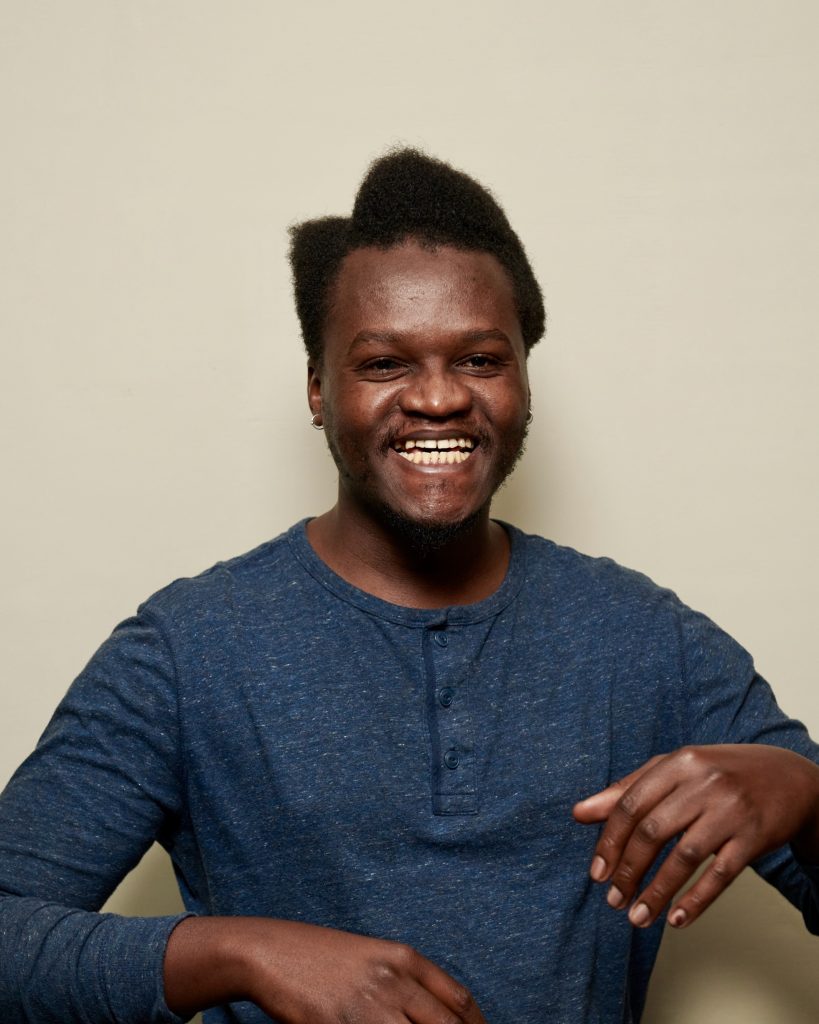
Photo taken at Durban Film Mart 2024.
This conversation took place over WhatsApp between Mutiganda in Kigali and Alain in Musanze.
ALAIN: I appreciate you making time for this conversation, Mutiganda. When I was at college in Kigali, my classmates and I would gather in the dining hall and watch Seburikoko on a tv set mounted on a wall. We laughed, and some of us were nicknamed after some of the characters. Though a comedy, it explores many humorless themes that your other work such as City Maid, Claire x Bosco, and Nameless tackle. Among them is rural-urban migration, financial struggles, and alcohol abuse to list a few. What inspired these themes?
MUTIGANDA: Well, I grew up in a village. Life had many layers, such as irresponsible alcohol-abusive men, families left struggling financially etc. When RBA asked us to make a comedy based on life in the village, it was very easy to gather ideas along with the show’s creator Wilson Misago since he also comes from the village. Every time I was writing Seburikoko I’d remember someone in my village whose life could resonate with the story. And other works of mine revolve around these same themes as you said above, because, first, I try to get as close as possible to reality of contemporary life when I’m writing, and also I’ve been influenced by social realist filmmakers such as Sembene, Scorsese, Satyajit Ray among many others.
ALAIN: Where did you grow up, and are there any specific experiences from your childhood that started your passion for screen writing and filmmaking?
MUTIGANDA: I grew up in Kanombe, Busanza (you ask why I said “village” haha!). Those who know Busanza from around 2000 know that it was a village, despite now being one of the hottest neighborhoods in Kigali. So, life then was very lonely. As a child I didn’t have many activities, and I despised football (karere). Then came udusobanuye. You could never find agasobanuye in Busanza, so I’d walk about 5km to go where they were: at the former Kabeza market (near Giporoso) or Kanombe/Kajagari to watch action films with the voice of Yanga or Master JK. When I was a kid, I had a passion for writing mostly poetry and songs. I used to perform during certain ceremonies such as AIDS day, Kwibuka etc. Then when I discovered that new magic of cinéma, it’s when I started to get stories’ inspirations. Growing up I never thought I could make films though. I wanted to be a journalist, but to become one you had to study literature. Instead I was given Biology and Chemistry because I had high grades in the national exam. That’s when my dream got delayed. When I finished high school, I was given agriculture in University, but the dream was still the same. I always wanted to be a journalist. Upon graduating, I saw a poster on Inyarwanda’s Facebook calling for journalism interns. I applied; despite not having a background in journalism, they accepted me, and I started right away. This is where I started to train myself into screenwriting because I had access to the internet, and I started to watch serious films. When my former boss (Wilson) said that he had a plan to make films, I was the first to jump on the boat. We made the first sitcom Inshuti: Friends, the very first series ever made in Rwanda, which I wrote, and it became successful, and from there came Seburikoko… the rest is history!
ALAIN: Yanga, may his soul rest in peace, played a huge role in the popularization of cinema in Rwanda. Your entire filmography is in Kinyarwanda. Your names themselves follow a specific traditional Rwandan naming custom. Like Ngũgĩ wa Thiong’o who changed his name from a Christian name, firstly is your emphasis on Kinyarwanda and its maintenance a decolonial tool? Secondly, doesn’t the usage of Kinyarwanda in your films affect their performance on other continents?
MUTIGANDA: My names being in Kinyarwanda, I also changed names like Ngugi you mentioned. I had a christian name, but as someone who values my own cultural roots, I always felt ashamed by that name. My philosophy is that you are named by your parents or your master, carrying the European/Christian names is always a symbol of colonialism, which in turn also comes from slavery. During the slavery period, a slave could carry their master’s name so that anyone who meets the slave could know who owns them. Changing my name was an act of decolonization, and I stand proud of that decision.
Making my films in Kinyarwanda is part of my artistic choice of telling my stories but also exporting my culture. Language is a very important cultural tapestry, and in a film a language carries very much more in the dialogues. It carries the cultural nuances, metaphors and that uniqueness of people. Kinyarwanda is one of the most sophisticated languages, and this makes films made in the language as unique and sophisticated. Colonization made us think that our languages don’t matter, and we were forced to value the colonizers’ languages more than ours. Today, many people think that making a film in English or French gives it a market potential, but not only are you taking away the story’s uniqueness, you are also not thinking that out there there is an audience hungry for discovering other cultures through your film. Reading the subtitles is not as hard as we think. The audience is there and they enjoy discovering other cultures.
ALAIN: I had not thought of those nuances before. Thank you. I watched Claire x Bosco the other day, and was impressed by your ability to document the struggles of life in Kigali under Covid-19. In the film, the couple struggles to pay rent. Nameless too tackles housing insecurity in Kigali. What do you hope to achieve with your work? Is it cultural preservation, is it archival, is it social criticism?
MUTIGANDA: Hahah, that’s a very hard question to answer as an artist. Every time I tell a story, I never think about what I want to achieve with it. What I always wish is that the audience might find something related to their own stories and think of the way around that. Every film I make has a time stamp on it. Claire x Bosco is during covid, Nameless before covid etc. I wish that in 100 years someone might see them and learn something about life when they were made.
ALAIN: Thank you for archiving our era and our sensibilities. Let’s shift to other filmmakers. At the screening of Myriam Birara’s The Bride at Goethe Institut in 2025, you hailed the film the most beautiful film ever made in Rwanda. Why?
MUTIGANDA: Myriam tackled the most difficult subject in a most nuanced and elegant way. Talking about the 1994 genocide against the Tutsis is not always simple, especially for a story set in that same era. Myriam found a way to tell that story as a backdrop of another overlooked story of bridal kidnapping, and overlaying both of them so intelligently. No other filmmaker has ever done that, and that’s why I hail that film.
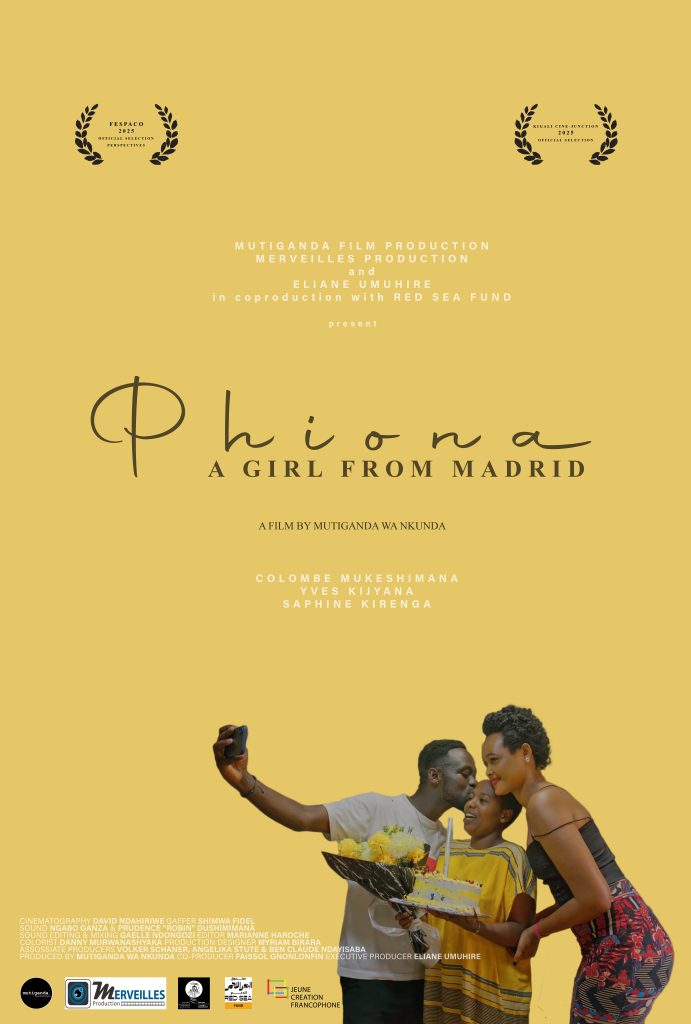
Phiona, A Girl From Madrid (dir. Mutiganda wa Nkunda)
ALAIN: I loved its cinematography too: the way it showcases the beauty of Rwandan green hills.
There is a rise in feature films in Rwanda. To name a few, The Bride by Myriam Birara, Ben’Imana by Marie Clémentine Dusabejambo, and your 2025 film Phiona, A Girl From Madrid. While some of them go on to be shown on streaming platforms such as Nameless that is on Prime Video and Claire x Bosco that I saw on Zacu TV, how do you ensure they are accessible to Rwandans? Speaking specifically of the feature films, not the series.
MUTIGANDA: Distribution is a very complicated matter for independent filmmakers not only in Rwanda but around the world. Making a feature film is very expensive, and because it’s a standalone work (not episodic), it’s always complicated to find a way for it to reach the audience. That’s general. Specific to Rwanda, people always ask me the same question: why aren’t your films on YouTube where we can watch them, or which platform can we watch your film on? You know, I hope I always have a good answer for myself too, because I always wish my films could be watched by as many Rwandans as possible because it’s our stories. But the problem is, as filmmakers we want to capitalize on our works and we don’t have distribution channels that are lucrative as we wish. But things are starting to look good. We have Zacu TV; it commissions feature films (I made MUCOMA for them), people are starting to understand the need for theatrical presence… I’m very optimistic that in 10 years, Rwandans won’t be asking that question anymore! Fingers crossed!
ALAIN: Fingers crossed.
Are any projects currently underway?
MUTIGANDA: Yeah, I’m working on multiple projects now. I’m writing a feature called MOTHER THERESA that I’ll be pitching at Durban Filmmart, I’m working on a short documentary hopefully I’ll be able to raise funds to shoot it by the end of the year, I’m also working on a short animation that I’m co-directing with the painter/animator Gilbert Iradukunda.
Those are the current projects I’m on now.
ALAIN: Good luck with each one of those projects. They sound like an ongoing expansion of your craft. I hope to see them on the screen in the future, especially that short animation.
MUTIGANDA: Thanks man!
Mutiganda wa Nkunda is a Rwandan filmmaker and and industry analyst. His debut feature film Nameless premiered at the Fribourg Film Festival 2021 and won the best screenplay at FESPACO 2021 among other international recognitions. He also directed and produced A LEGACY for Al Jazeera and his second feature film PHIONA, A GIRL FROM MADRID premiered at FESPACO 2025. MUCOMA: THE BATTLE OF A COUPLE, his 2025 TV film was nominated for AMA Awards for Best Actress in a Leading Role.