




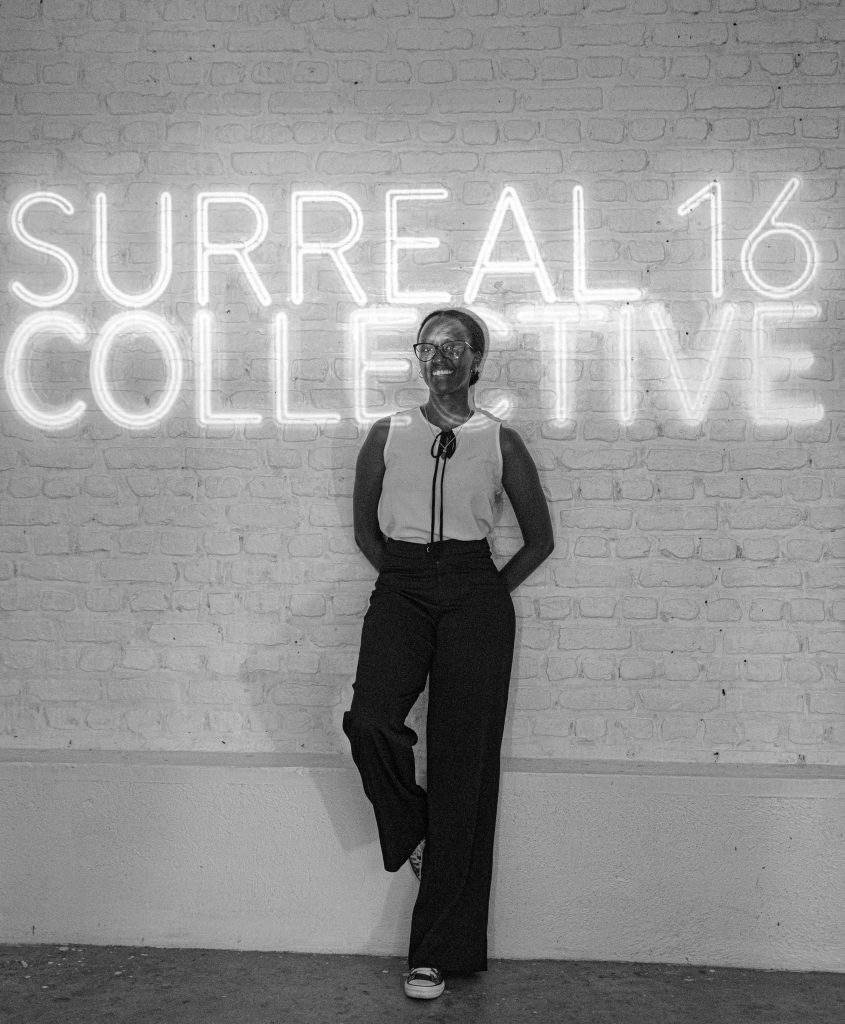
Photo Courtesy of Remy Ryumugabe.
This conversation took place over WhatsApp between Inès in Kigali and Alain Jules Hirwa in Musanze.
ALAIN: It is a pleasure to be in conversation with you, Inès. My first question is—So, the first films I watched as a child were Sarafina!, Titanic, and Karishika, in that order, spanning across different genres and countries—what were your first encounters with moving pictures, where did you watch them/under which circumstances, and did those films influence your eventual career in filmmaking?
INÈS: When you mentioned Sarafina!, it brought back my earliest memories of watching the film. It’s the first one I clearly remember watching. At the time, we had a VCR (Magnéto) and a few cassette tapes, and Sarafina! was one of them. I was very young, and every morning, midday, or afternoon, I would be sitting in front of the TV watching it. I watched it sooo many times, and the funny thing is, I didn’t fully understand the context. I just knew it was about a girl named Sarafina who faced so many injustices but, in the end, she won.
Later, our VCR and TV were stolen, and my heart was broken. I couldn’t watch Sarafina! anymore. Eventually, I forgot about it. Then, years later, when I was an adult, I was surfing the internet and came across Sarafina!. I was like, “Oh my God! Sarafina!” That’s when I realized the film was so much deeper than I had understood as a child. I have to watch it again.
Another film series that shaped my childhood was the James Bond films with Pierce Brosnan! I watched them sooo many times! By then we had CDs. Pierce Brosnan was my James Bond, and it took me a while to appreciate Daniel Craig. At the time, I didn’t even know there had been other actors before him.
Later on, I watched films on TV and cartoons, but I especially remember a period when I was heavily into kung fu films, followed by Indian films.
None of those films influenced me to become a filmmaker. I didn’t even know becoming a filmmaker or making films here in Rwanda was a possibility. After secondary school, I was just looking for a way into the arts, but I wasn’t finding what I wanted. Then, during my search, I saw people walking/playing around with cameras. They told me it was the film department. I thought it looked cool, and I was like, “I want to do that.”
It wasn’t as cool as I had imagined, but I stayed, and I figured my way through it.
ALAIN: Sarafina! likely occupies a cherished place in the hearts of Rwanda’s generation post 1994 Genocide against the Tutsi.
Your earlier journey of watching films resembles mine, especially in its lack of Rwandan films. In the past couple of years, I have been discovering Rwandan cinema. It’s a rich cinema. Of course, growing up, I saw soap operas on RTV, but I was not aware of Rwandan standalone films. What was your personal discovery of Rwandan cinema, both standalone films and TV shows? As a person more literate about Rwandan cinema, can you take me through a brief history of Rwandan standalone films, even a list would be appreciated?
INÈS: Yes, our film-watching habits were definitely lacking Rwandan films, as our film industry is relatively very young. My main form of local entertainment was ikinamico, and later series like the beloved Kanyombya (Haranira Kubaho and Zirara Zishya), Ikigeragezo cy’Ubuzima, and Amarira y’Urukundo. Those were bangers!!!
I wasn’t aware of feature or short films made by Rwandan filmmakers until about nine years ago. Of course, I knew about the big productions like 100 Days, Sometimes in April, and others about the Genocide. But apart from being filmed in Rwanda and featuring Rwandans (Except 100 Days which was Co-produced by Eric Kabera), I didn’t know there was an independent cinema scene here. That’s when I started interacting with the community, had the chance to watch these amazing films I didn’t even know existed, and met so many incredible artists and filmmakers.
As for a list and a brief history, I’d rather you do a little research yourself for the most accurate and up-to-date information, it’s all over the internet these days.
ALAIN: The Rwandan film industry is growing rapidly! There are many films recently released, and they all expand on our history and culture. The Bride by Myriam Birara tackles Guterura, and Ben’Imana by Marie Clémentine Dusabejambo documents Gacaca. Many films indeed. Anyway, above you mention that you discovered filmmaking as a field of study when looking for a way into the arts. Your debut film, Breaking Ground, features a poem. Which arts were you practicing growing up, and how do they shape your filmmaking now?
INÈS: I didn’t particularly grow up practicing anything specific in the arts, but of course, as I previously mentioned, I watched lots and lots of films, whatever I could get my hands on, as a form of entertainment, and I loved ikinamico!
Close to my teens, I started drawing a lot, a craft I eventually abandoned somewhere along the way. I also enjoyed delving into fiction, thriller, and sci-fi novels. Later on, I really enjoyed making things out of things that may no longer have been useful, such as bracelets, necklaces, decorations, etc. Think of those internet DIY projects. I still enjoy this, just with less and less time to indulge in all my hobbies.
Filmmaking came from a need to express my thoughts, ideas, and emotions. I take from my experiences, my surroundings, the people close to me, what I’m learning, and my thoughts at the time. As a producer too, I engage with projects in much the same way, a genuine filmmaker trying to express something.
Now, I expand my knowledge and perspective through reading here and there and watching films, but this time with more intentionality and awareness.
ALAIN: What has been inspiring you lately?
INÈS: That’s a tricky one. But I’ve always been fascinated by femme fatales. I hope to make a film about one someday.
ALAIN: I look forward to watching your future films, including that one! Thank you for having this conversation with me.
Inès GIRIHIRWE is an independent filmmaker and producer based in Kigali, Rwanda, and co-founder of KAZI Productions.Her films have screened at festivals internationally. Her earlier film Breaking Ground received several accolades, including the Uppsala Award in Memory of Ingmar Bergman and the Sembene Ousmane Award. In her work, she explores the obsessions that occupy her at a given time, using filmmaking as a way to process her thoughts, feelings, and experiences. Her work moves between fiction, documentary, and hybrid forms.
As a producer with KAZI Productions, she seeks to keep the creative process accessible and affordable. She has produced internationally recognised films including A Wingless Bird that Flies, which won the Golden YAFMA at the Afrika Film Festival Leuven, and Things in a Psyche of an Awake Dreamer, which had its world premiere in the International Competition at the Uppsala Short Film Festival before screening at several other festivals.
Most recently, she produced Murmurs from the Wind, which screened at the 25th edition of the Festival International du Cinéma Africain de Khouribga.
She is currently involved in several projects at different stages of development and production through KAZI Productions